


Dozens of laid-off workers and labor activists yesterday clashed with police as they protested in Taipei against the Council of Labor Affairs’ (CLA) pursuit of money granted to them as layoff loans and retirement payouts.
“We want to get on the sky bridge! How can you block the sky bridge? Everyone has the right to use it!” protestors shouted as they pushed and shoved against police officers blocking them from getting on the pedestrian sky bridge at the intersection of Zhongxiao W Road and Zhongshan S Road.
“Please stop pushing and attacking officers, you are not only in violation of the Assembly and Parade Act (集會遊行法), but also involved in the offense of obstructing official duties,” a police officer said through a loudspeaker, but it did not deter the demonstrators.
“We’re just trying to get on the sky bridge, you have violated our freedom of movement!” people in the crowd shouted back.
The laid-off workers were from several textile and electronic parts manufacturers that closed down in the 1990s because of financial problems.
Instead of giving their employees layoff and retirement payments, the employers either declared bankruptcy or fled overseas.
The council came up with a solution to give these laid-off workers proper payouts in the form of loans.
At first, the workers rejected the solution, but they eventually accepted the proposal as the council promised them that they would not have to pay the money back. The council said it would seek the money from their employers.
However, since the council is still not able to get the money back from the former employers, it has requested the laid-off former workers to repay their loans. It has recently filed lawsuits against those who have been unable to do so.
“The CLA told us that we wouldn’t have to pay back the loan and they would get the employer to repay, that’s why I agreed to the proposal,” former Lien-fu Textile Co employee Chao Hsueh-jung (趙學榮) said.
“The CLA is now asking me to repay NT$430,000, but how could I possibly have that much money? I’m 88 years old and I have a paralyzed wife to take care of,” he added.
Chao said he was born in China in 1925 and survived World War II and the Chinese Civil War, “but now the government is killing me.”
“If the CLA does not stop pursuing [us], I will kill myself in front of the courthouse. I’m 88 years old, I’ve lived long enough,” he said.
After trying fruitlessly to break the police line, the protesters sat on Zhongshan S Road, blocking the outer lane of traffic.
Zhongzheng First Precinct police chief Fang Yang-ning (方仰寧) threatened to charge them with creating a public hazard.
However, as the demonstrators refused to back off, police compromised and escorted them to the Taipei Railway Station, where they handed out flyers to passersby.
The demonstrators planned to perform a skit on the sky bridge modeled on a scene from the Taiwanese movie No Puedo Vivir Sin Ti (不能沒有你), in which a father tried to jump off the sky bridge with his daughter in protest.
The movie was based on a true story in which the father did just that, because social workers tried to take his daughter away from him and give her to a foster family because they said he may not be able to support the child.
The demonstrators said if Council of Labor Affairs Minister Jennifer Wang (王如玄) does not negotiate with them before tomorrow, they would block the MRT metro rail system in Taipei tomorrow.

UPGRADE: The Kang Ding-class frigate is replacing its Chaparall missiles with Tien Chien II and Hua Yang VLS, which would provide it with long-range, 360° air defense Taiwan plans to produce 1,200 to 1,376 Hai Chien II missiles (海劍二, Sea Sword II) — also known as TC-2N — to serve as the standard air defense system of the navy’s surface combatant fleet, a source said yesterday. Last week, the Hai Chien II, the naval version of the Tien Kung II missile (天劍二, Sky Sword II), completed a live-fire test in waters off the National Chungshan Institute of Science and Technology’s Jiupeng facility (九鵬) in Pingtung County’s Manjhou Township (滿州). The MIM72 Chaparral and other dated air defense missiles that currently arm Taiwanese ships have inadequate range to combat Chinese

REASONS FOR TRAVEL: An assistant professor said that proposed amendments to penalize drivers if they used drugs overseas would not deter people from traveling People who operate a motor vehicle under the influence of marijuana would have their driver’s license revoked, even if they used the substance while overseas, the Ministry of Transportation and Communications said yesterday, citing proposed amendments to the Road Traffic Management and Penalty Act (道路交通管理處罰條例). The amendments would also authorize the government to revoke the licenses of people determined to have used Category 1 or Category 2 narcotics, even if they were not operating a vehicle while under the influence of drugs, as well as ban them from taking the license test for three years, the ministry said. People aged 18 or

HEAVY WEATHER: Typhoon Jangmi is due to crash straight into the Ryukyus as airlines look to shift flights to larger aircraft or cancel flights to Okinawa entirely Taiwan’s international air carriers announced flight adjustments over the weekend as Typhoon Jangmi is forecast to hit the Ryukyu Islands today and tomorrow. The Central Weather Administration (CWA) upgraded Jangmi from a tropical storm to a typhoon at 8am yesterday, with the eye located 580km south of Naha city. It was moving north at 19kph. Today, China Airlines’ CI-120, CI-121, CI-122 and CI-123 flights between Taoyuan and Naha, Okinawa, have been canceled as well as CI-132 and CI-133 between Kaohsiung and Naha. EVA Air’s BR-112, BR-113, BR-186 and BR-185 flights between Taoyuan and Naha are also canceled. Low-cost carrier Tigerair Taiwan canceled IT-230,
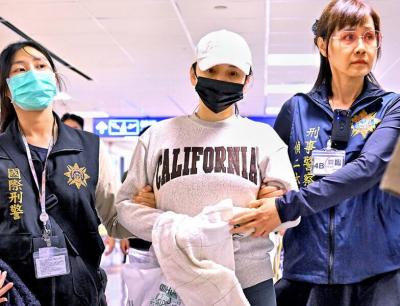
Johanne Liou (劉喬安), a Taiwanese woman who shot to unwanted fame during the Sunflower movement protests in 2014, returned to Taiwan last night after being deported from the US. She is to stand trial in Taiwan for charges involving embezzlement, fraud and drug crimes. The Criminal Investigation Bureau (CIB) said it took her into custody at Taiwan Taoyuan International Airport and would first question her before transferring her to the New Taipei District Prosecutors’ Office. She was arrested upon disembarking a flight from San Francisco that landed shortly before 7pm. Liou absconded to the US in 2019 after jumping bail


 RSS
RSS